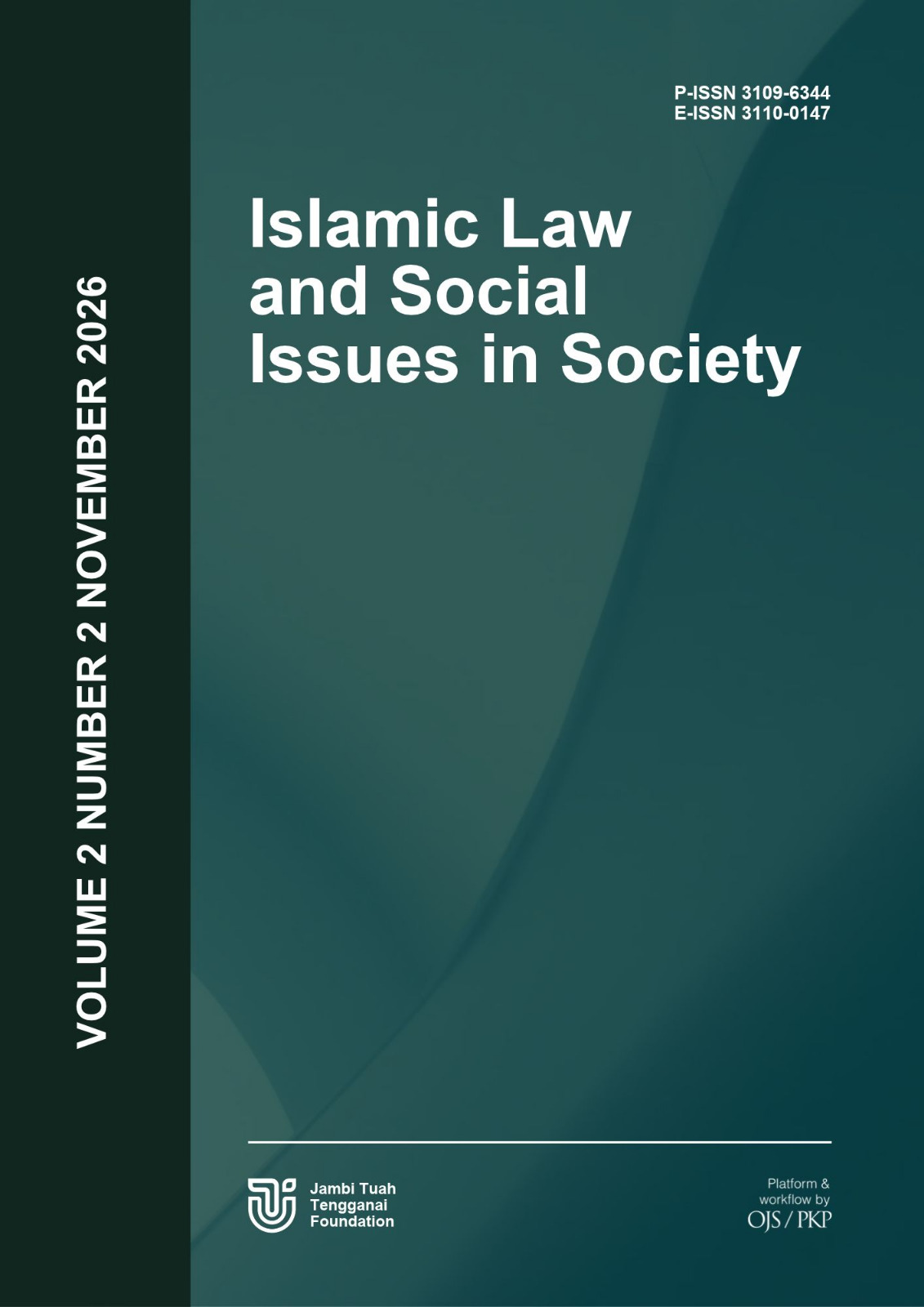
Codifying ʿUrf, Negotiating Taʻzīr: Legal Discourse and Sharia–Adat–State Interaction in the Written Customary Law of Desa Semundam, Mukomuko
DOI:
https://doi.org/10.64929/ilsiis.v2i2.64Keywords:
ʿUrf Codification, Taʻzīr, Legal Pluralism, Malay Customary Law, MukomukoAbstract
The codification of customary law in Muslim-majority Indonesian villages raises important questions about how Islamic legal concepts are linguistically and discursively translated, localized, and contested in the transformation of oral ʿurf (custom) into written village regulation, a dimension that remains insufficiently examined in existing scholarship on Sharia–adat–state legal pluralism. To address this gap, this study analyzes the Semundam Village Customary Regulation No. 01 of 2024, a recently codified customary regulation in Mukomuko, Bengkulu, that combines Islamic legal terminology, Malay-adat idioms, and state legal references. Drawing on Islamic legal theory, legal pluralism, and critical discourse analysis (CDA), the study examines the regulation’s 22 articles and interviews conducted in June 2025 with key local stakeholders, including customary, religious, village, community, and youth representatives. The study finds that, first, ʿurf codification in Desa Semundam operates as a discursive strategy to stabilize local authority through administrative form and a stated commitment to compatibility with state criminal law; second, customary sanctions expressed through Malay-adat idioms exhibit functional affinities with taʻzīr, while interview accounts reveal both restorative aspirations and social and economic burdens; and third, the regulation’s legal language systematically negotiates three normative authorities, Sharia, adat, and state, through lexical choice, modality, and code-mixing, while its practical acceptance remains subject to deliberation, fairness, and protection needs. The study contributes to legal pluralism scholarship by identifying mechanisms of normative hybridization within a village regulation. It proposes an interdisciplinary framework for examining textual authority claims alongside local accounts of their interpretation.
Downloads
Published
How to Cite
Issue
Section
Citation Check
License
Copyright (c) 2026 Fauzan, Andri Saputra

This work is licensed under a Creative Commons Attribution-ShareAlike 4.0 International License.